Darts Scoring Explained: How Every Zone on the Board Scores
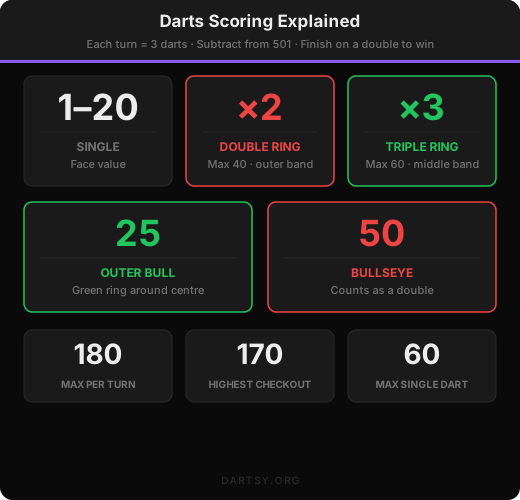
In darts, you score by landing in numbered segments on the board. Each segment scores its face value (1–20) in the large single area, double in the thin outer ring, and triple in the thin inner ring. The outer bullseye scores 25; the inner bull scores 50 (and counts as a double). The highest single-dart score is 60 (T20); the highest three-dart score is 180 (three T20s).
Every number on a dartboard has a purpose, and every ring changes what that number is worth. Whether you have just picked up your first set of darts or you have been playing casually and want to finally understand what all the segments mean, this guide breaks down the entire dart board points system — from the single segments to the bullseye.
How the Dart Board Points System Works
A dartboard is divided into 20 numbered segments arranged in a deliberate, non-sequential order. The layout is designed so that high numbers sit next to low numbers — miss the 20, and you are likely to land in 1 or 5. This rewards accuracy over luck.
Each numbered segment contains four distinct scoring zones:
| Zone | What It Scores | Example (Segment 20) |
|---|---|---|
| Single (large area) | Face value | 20 points |
| Double ring (thin outer band) | 2x face value | D20 = 40 points |
| Triple ring (thin inner band) | 3x face value | T20 = 60 points |
| Single (small area between triple and bull) | Face value | 20 points |
Plus the center of the board:
| Zone | Score |
|---|---|
| Outer bull (green ring) | 25 points |
| Inner bull (red center) | 50 points (counts as a double) |
Miss the board entirely? That scores zero.
Note
The triple ring is the thin band about halfway up the segment — not the outer ring. Many beginners assume the outermost ring is worth more, but the outer ring is the double, and the inner ring is the triple. The triple is smaller and harder to hit, which is why it rewards three times the value.
How Many Points Is a Bullseye?
The bullseye is actually two separate scoring areas:
- Outer bull (the larger green ring): 25 points
- Inner bull (the small red dot in the center): 50 points
The inner bull counts as a double in standard rules. This matters in games like 501 and 301 where you must finish on a double — if you have exactly 50 remaining, you can hit the inner bullseye to win the game.
The outer bull does not count as a double. It is a single score of 25 and cannot be used to check out in double-out games.
Bullseye Scoring in Cricket
In Cricket, the bullseye works slightly differently. Both the inner and outer bull count toward "closing" the bullseye:
- Outer bull = 1 mark (worth 25 when scoring points)
- Inner bull = 2 marks (worth 50 when scoring points)
You need 3 marks to close the bullseye, same as any other number. A single inner bull plus an outer bull gives you all 3 marks in two darts.
Singles, Doubles, and Triples — The Complete Breakdown
Singles
The two large areas of each segment — one between the triple ring and the double ring, and one between the triple ring and the bullseye — are both singles. They score face value.
Singles are the largest target areas on the board, so they are the easiest to hit. When someone says they "scored 60" on a turn, they probably hit three single twenties (20 + 20 + 20), not a triple twenty.
The Double Ring
The thin outermost ring of the board is the double ring. Every number has a double worth twice its face value:
D20= 40D16= 32D10= 20D1= 2
Doubles are critical in 501 and 301 because you must land your final dart in the double ring (or the inner bullseye) to finish the game. This is called double out, and it is the rule that adds real strategy to darts.
The Triple Ring
The thin ring roughly halfway between the outer edge and the bullseye is the triple ring. It scores three times the segment value:
T20= 60 (the highest single-dart score on the board)T19= 57T18= 54T1= 3
The triple 20 is where most competitive players aim during the scoring phase of 501. Three triple twenties scores 180 — the maximum possible with three darts and the iconic "one hundred and eighty!" you hear during televised matches.
Pro Tip
The triple ring is roughly 8mm wide — about the width of a pencil. That is why even professional players do not hit it every throw. If you are landing in the single 20 consistently, you are already scoring well. The triples will come with practice.
Complete Dartboard Scoring Reference
Here is every possible score on a standard dartboard, organized by segment:
| Segment | Single | Double | Triple |
|---|---|---|---|
| 20 | 20 | 40 | 60 |
| 19 | 19 | 38 | 57 |
| 18 | 18 | 36 | 54 |
| 17 | 17 | 34 | 51 |
| 16 | 16 | 32 | 48 |
| 15 | 15 | 30 | 45 |
| 14 | 14 | 28 | 42 |
| 13 | 13 | 26 | 39 |
| 12 | 12 | 24 | 36 |
| 11 | 11 | 22 | 33 |
| 10 | 10 | 20 | 30 |
| 9 | 9 | 18 | 27 |
| 8 | 8 | 16 | 24 |
| 7 | 7 | 14 | 21 |
| 6 | 6 | 12 | 18 |
| 5 | 5 | 10 | 15 |
| 4 | 4 | 8 | 12 |
| 3 | 3 | 6 | 9 |
| 2 | 2 | 4 | 6 |
| 1 | 1 | 2 | 3 |
| Outer bull | 25 | — | — |
| Inner bull | 50 (double) | — | — |
That gives a total of 82 distinct scoring areas across the entire board.
Darts Scoring Rules by Game
The board is always the same, but how you use it depends on which game you are playing. Here is how scoring works in the most popular formats.
501 and 301 Scoring
Both are countdown games. You start at 501 (or 301) and subtract your score each turn until you reach exactly zero. The key darts scoring rules:
- Each turn you throw 3 darts
- Add up the total for all three darts and subtract from your remaining score
- You must finish on a double (or the inner bullseye)
- If you go past zero, or land on 1 (impossible to finish on a double), your turn is a "bust" and your score resets
For a full explanation of finishing rules, see our double out guide. For the best finishing combinations from any score, see the 501 checkout chart.
Cricket Scoring
Cricket uses only seven numbers: 20, 19, 18, 17, 16, 15, and the bullseye. Scoring is based on marks rather than point totals:
- Single = 1 mark
- Double = 2 marks
- Triple = 3 marks
- You need 3 marks to "close" a number
- Once closed, additional hits on that number score points (face value) — but only if your opponent has not also closed it
Read the full Cricket rules and strategy guide for a complete breakdown.
Around the Clock Scoring
The simplest scoring system: hit numbers 1 through 20 in order. No points, no math — just progression. Doubles and triples count as hitting the number, but do not advance you further. It is the best game for beginners learning the board layout. See our Around the Clock rules for all the variations.
Common Scoring Mistakes Beginners Make
Confusing the double and triple rings. The outermost ring is the double. The ring closer to the center (about halfway up the segment) is the triple. It is counterintuitive because you would expect the outer ring to score more, but it does not.
Thinking the bullseye is the highest-scoring target. The inner bullseye scores 50 — impressive, but triple 20 scores 60. That is why professional players aim at the top of the board, not the center.
Forgetting that outer bull and inner bull are different. In 501 with double out, only the inner bull (50) counts as a double. The outer bull (25) is just 25 points and cannot be used to check out.
Not counting triples correctly. T19 is 57, not 60. T18 is 54. When you are adding up your three-dart score, make sure you are multiplying the right number. A dart in the triple ring of the 5 segment is only 15, not 60.
Warning
A common scoring dispute at the pub: if a dart lands on the wire between two segments, it scores whichever segment the point of the dart is actually in. If the dart falls out of the board before you pull your darts, it scores zero in most official rules. House rules may vary.
Quick Mental Math for Scoring
Adding up three-dart scores under pressure is one of the parts of darts that intimidates beginners most. A few shortcuts:
- All three in the 20 segment: Single 20 = 20, two singles = 40, three singles = 60.
T20= 60, soT20+ single 20 + single 20 = 100. - Round to 10s when casual: If you hit 19, 5, and 13, round to 20 + 5 + 15 = 40. Close enough for a friendly game.
- Memorize the common totals: 26 (single 20 + single 5 + single 1), 60 (single 20 x3), 100 (T20 + two single 20s), 140 (T20 + T20 + single 20).
- Or skip the math entirely: use Dartsy to track scores automatically. Tap what you hit and the app handles subtraction, checkout suggestions, and stats.
Frequently Asked Questions
How many points is a bullseye in darts?
The outer bull (green ring) is worth 25 points. The inner bull (red center) is worth 50 points and counts as a double, so you can finish a game of 501 or 301 by hitting it when you have exactly 50 remaining.
What is the highest score with three darts?
The maximum three-dart score is 180: triple 20 (T20) three times. Each T20 is worth 60 points. Hitting 180 is one of the most celebrated moments in darts and earns the famous "one hundred and eighty!" call.
How many scoring areas are on a dartboard?
A standard dartboard has 82 scoring areas: 20 single sections (between triple and double), 20 single sections (between triple and bull), 20 doubles, 20 triples, the outer bull, and the inner bull. The area outside the double ring scores zero.
Which ring is the triple in darts?
The triple ring is the thin band located roughly halfway between the outer edge and the bullseye — it is the inner of the two thin rings. The outer thin ring is the double. Many beginners mix these up because the outer ring seems like it should be worth more.
Does the bullseye count as a double?
The inner bullseye (50 points) counts as a double in official rules. You can use it to check out in 501 or 301 if you have exactly 50 left. The outer bull (25 points) does not count as a double.
Start Scoring
Now that you understand every scoring zone on the board, the natural next step is learning how to run the scoreboard during an actual game. The guide to how to keep score in darts covers the 501 countdown method, the Cricket marks system, and chalking conventions — so you are ready for both sides of the match.\n\nThe best way to internalize the zones is to play. Fire up a 501 game on Dartsy and watch how your three-dart totals add up. The app calculates everything automatically — your score, your remaining total, and the best checkout route when you are in finishing range. The more you play, the faster the board layout clicks, and the sooner you stop having to think about what each ring is worth.
Related Rules
Ready to Practice?
Put these tips into action with Dartsy.