Cricket Darts: Rules, Scoring & Strategy Guide
Cricket is the most popular dart game in North America, and for good reason. It rewards both accuracy and strategy, making every turn a decision between attacking and defending. Whether you're learning the game or looking to sharpen your tactics, this guide covers everything from the basic rules to advanced strategy. For a quick rules reference, see the Cricket rules page.
How Cricket Works
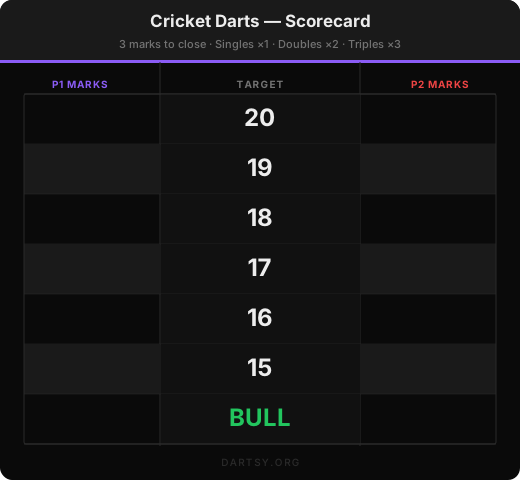
Cricket uses just seven targets on the dartboard: 20, 19, 18, 17, 16, 15, and the Bullseye. Every other number is irrelevant—hitting a 12 or a 3 does nothing.
Each player's goal is to close all seven numbers by hitting each one three times, while also finishing with equal or more points than their opponent. You need both to win.
The Marking System
Traditional Cricket scorekeeping uses slash marks:
| Marks | Symbol | Meaning |
|---|---|---|
| 1 hit | / | One mark toward closing |
| 2 hits | X | Two marks toward closing |
| 3 hits | ⊗ | Number is closed |
Doubles count as 2 marks and triples count as 3, so a single T20 closes the 20 in one dart. The inner bullseye counts as 2 marks, while the outer bull counts as 1.
Scoring Points
Once you've closed a number (3 marks), any additional hits on that number score points equal to its face value—but only if your opponent hasn't closed it yet. When both players close the same number, it's dead and nobody can score on it.
This is where Cricket gets interesting. Closing numbers is necessary to win, but scoring points is how you build a lead and apply pressure.
Note
You must close all seven numbers AND have equal or more points than your opponent to win. Closing everything first doesn't guarantee victory if you're behind on points.
The Strategy: Offense vs Defense
Every turn in Cricket forces a choice: do you close new numbers or score points on numbers you've already closed? The answer depends on your position in the game.
When You're Ahead on Points
If you have a comfortable points lead, focus on closing numbers. Your opponent can't win while you're ahead, so shutting down the board removes their options. Close numbers your opponent is scoring on first to cut off their point supply, then finish the rest.
When You're Behind on Points
You need points before you can win, even if you close everything. Look for numbers where you're closed and your opponent isn't—that's where you can score. Pile up points on high-value numbers like 20 and 19 to close the gap.
When It's Even
This is where the game gets tactical. Most experienced players default to an aggressive closing strategy, working top-down from 20. Closing high numbers first gives you access to the highest-value scoring opportunities if you need them later.
Number Order: Top-Down Strategy
The standard approach is to close numbers from highest to lowest: 20, 19, 18, 17, 16, 15, then Bull. Here's why this works:
| Number | Value per Hit | Triple Value | Why It Matters |
|---|---|---|---|
| 20 | 20 pts | 60 pts | Highest scoring potential |
| 19 | 19 pts | 57 pts | Strong scoring, close to T20 on board |
| 18 | 18 pts | 54 pts | Solid value, natural progression |
| 17 | 17 pts | 51 pts | Mid-range value |
| 16 | 16 pts | 48 pts | Lower priority |
| 15 | 15 pts | 45 pts | Lowest numbered target |
| Bull | 25/50 pts | N/A | Hardest target, saved for last |
By closing 20 first, you unlock the most valuable scoring number on the board. If your opponent falls behind on 20, every hit you land there is worth 20 points (or 60 on a triple).
Pro Tip
Don't be rigid about the order. If you've thrown two marks at 19 but zero at 20, it's often smarter to close the 19 with your next dart rather than switching targets.
The Bullseye Decision
The bull is the hardest target on the board, which is why most players save it for last. But there are situations where going after it early makes sense.
Save the bull for last when:
- You're in a close game and can't afford to waste darts on a tough target
- You're behind on points and need to score on easier numbers
- Your opponent hasn't started on the bull either
Attack the bull early when:
- You're comfortably ahead on points and closing quickly
- Your opponent has already closed the bull and could score 50-point hits on you
- You're a strong bull shooter and can close it efficiently
The inner bull (50 points, 2 marks) makes the bullseye a dangerous scoring number. If your opponent closes it while yours is still open, they can rack up 50 points per inner bull—a swing that's hard to recover from.
Reading the Scoreboard
Good Cricket players constantly read the scoreboard to make decisions. Before each turn, ask yourself:
- Am I ahead or behind on points? This determines offense vs defense.
- Which numbers is my opponent close to closing? Prioritize closing those to stop their scoring.
- Where can I score? Look for numbers you've closed that your opponent hasn't.
- How many numbers does each player have left? If you're both close to finishing, points become critical.
Warning
A common beginner mistake is racing to close all numbers without paying attention to points. If you close everything but you're behind by 100 points, you haven't won—and now you have no way to score.
Three-Dart Turn Planning
You get three darts per turn. Planning how to use them is what separates experienced players from beginners.
Scenario 1: Two Marks on 20
You have 2 marks on 20 and your opponent has 0. Your first dart should target 20 to close it. If you hit a single, you're closed—now your remaining two darts can score on 20 (potentially 40 or even 120 points with two triples). If you miss, you've still got two more chances.
Scenario 2: Behind by 60 Points
You've closed 20 and 19. Your opponent has closed 20 but not 19. Instead of moving to 18, throw at 19 to score. Three single 19s earn you 57 points, nearly erasing the deficit. A triple 19 alone gets you there.
Scenario 3: Opponent Is Scoring on You
Your opponent has closed 20 and you haven't. They're piling up points every turn. Drop everything and close 20 to stop the bleeding. Giving up 40-60 points per turn is unsustainable.
Common Mistakes
Ignoring the Scoreboard
Cricket isn't just about throwing at numbers in order. Pay attention to what your opponent is doing and adjust your strategy.
Chasing Points When Ahead
If you're leading by 100 points, stop scoring and start closing. Extra points beyond what you need are wasted darts that could be closing numbers.
Avoiding the Bull Too Long
The bull is hard, but leaving it until you absolutely need it adds pressure. Consider working on it whenever you have a comfortable lead, even mid-game.
Playing the Same Strategy Every Game
Your approach should change based on your opponent. Against a weaker player, straightforward closing works fine. Against someone who's strong at scoring, you may need to match them point for point.
Cricket Variations
Once you're comfortable with standard Cricket, try these popular variations:
Cut-Throat Cricket (3+ players): Points are scored against other players, not for yourself. The player with the lowest score when all numbers are closed wins. This flips the strategy entirely—you want to close numbers defensively while scoring on opponents.
No-Score Cricket: Pure closing, no points. First player to close all seven numbers wins. This is simpler and faster, good for practicing accuracy without the strategic layer.
Wild Cricket: Numbers are determined randomly rather than using 15-20. Each player throws one dart to select the numbers in play. This keeps the game unpredictable and tests your accuracy across the whole board.
Quick Reference
Here's a summary you can reference during games:
| Situation | Action |
|---|---|
| Ahead on points | Close numbers, shut down the board |
| Behind on points | Score on numbers opponent hasn't closed |
| Even on points | Close top-down (20, 19, 18...) |
| Opponent scoring on you | Close that number immediately |
| Comfortable lead | Consider closing the bull early |
| Numbers almost done | Make sure points are even or ahead |
Summary
Cricket rewards players who can balance two objectives: closing numbers and managing points. The rules are simple—hit numbers three times to close them, score on closed numbers your opponent hasn't closed, and finish with all numbers closed and the most points.
The strategy is where it gets fun. Read the scoreboard, adapt your approach, and think about each three-dart turn as a mini-puzzle. Should you close a new number, score points, or play defense?
Ready to put these strategies to work? If you want to understand how scoring zones like doubles and triples work across the whole board, see our darts scoring explained guide. Start a Cricket game on Dartsy and see how your tactical decisions play out.
Related Rules
Ready to Practice?
Put these tips into action with Dartsy.