501 Checkout Chart — Every Finish from 170 to 2 (Printable)
Knowing your checkouts is the difference between winning and losing in 501 darts. While you can always check a chart mid-game, having the common finishes memorized will speed up your game and give you a mental edge over your opponents.
What is a Checkout?
A checkout is the combination of darts needed to finish a game of 501 (or 301) by reaching exactly zero. The key rule: your final dart must land on a double (the outer narrow ring) or the bullseye.
The highest possible checkout is 170 (Triple 20, Triple 20, Bullseye), and any score above this cannot be finished in three darts.
The Most Important Checkouts to Memorize
You don't need to memorize every checkout. Focus on these high-frequency finishes first:
Two-Dart Finishes (100 and below)
These are the checkouts you'll attempt most often:
| Score | Checkout | Why It's Common |
|---|---|---|
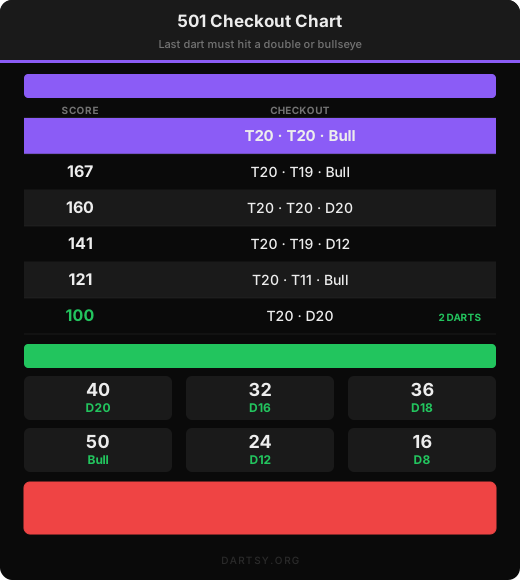
| 40 | D20 | The most targeted finish |
| 32 | D16 | Miss single leaves D8 |
| 36 | D18 | Popular safety number |
| 24 | D12 | Clean double |
| 16 | D8 | Common leave from 32 |
Common Setup Numbers
When you can't finish in your current turn, leave yourself these numbers:
- 32 - The classic. Hit single 16? You're on D8. Hit single 8? You're on D4.
- 40 - D20 is the biggest double on the board
- 36 - D18 leaves D9 on a miss
- 24 - D12 is comfortable for most players
Strategy: Think Backwards
The best players think backwards from their target double. Here's how:
- Know your favorite double - Most pros prefer D16 or D20
- Calculate what you need - If you have 81 and like D16, you need 49 first (T19 leaves 24... not ideal). Better: T15 leaves 36 (D18).
- Leave yourself options - Odd numbers are harder because you must hit a single first
Pro Tip
Practice your doubles in isolation. Spend 10 minutes just throwing at D16, then D20, then D8. Knowing which double you're most accurate at will inform your checkout strategy.
The Bogey Numbers
Some numbers are "impossible" checkouts because no three-dart combination can reach them while finishing on a double:
- 169, 168, 166, 165, 163, 162
If you land on one of these, you'll need to set up a different number on your next visit.
Common Three-Dart Finishes
For scores between 101-170, you'll need all three darts:
| Score | Checkout | Notes |
|---|---|---|
| 170 | T20 T20 Bull | The big fish |
| 167 | T20 T19 Bull | Second highest |
| 160 | T20 T20 D20 | No bull needed |
| 141 | T20 T19 D12 | Common in matches |
| 121 | T20 11 D25 | Awkward but doable |
| 100 | T20 D20 | Two darts only! |
Tips for Improving Your Checkouts
1. Start with the finish
When you're below 170, identify your out immediately. Don't throw your first dart without a plan.
2. Leave even numbers
Odd numbers require hitting a single first, adding difficulty. Always try to leave yourself an even number.
3. Practice under pressure
Set up scenarios in practice: "I have 76 left with two darts." This builds muscle memory for match situations.
4. Know your bail-outs
If you miss your first dart at a triple, know what single leaves you a finish. Example: Going for T19 to leave D20? Single 19 leaves 57 - still finishable with T19 D0... wait, that's not right. Single 19 leaves 57 which needs 17 D20. Know these bail-out routes.
Note
The 501 Rules page has a complete checkout chart from 170 down to 2 that you can reference during games. Want a copy for the wall? Grab the printable checkout chart — it's designed to print on a single page.
Practicing Checkouts
Here's a practice routine to improve your finishing:
- Start at 100 - Throw until you check out, count your darts
- Random checkout game - Start at a random number (61-100) and finish
- Pressure practice - Give yourself only 9 darts to finish from 100
- Double trouble - Start at 32 and work through D16, D8, D4, D2, D1
Track your checkout percentage over time. Professional players finish around 40% of their attempts at double - if you're hitting 25%+, you're doing well for a club player.
Frequently Asked Questions
What is the highest possible checkout in 501?
The highest possible checkout is 170: T20 T20 Bull. Any score above 170 cannot be finished in a single visit of three darts.
Do you have to finish on a double in 501?
Yes. Your final dart must land on a double (the outer narrow ring) or the bullseye, which counts as a double. If your score goes below 2, or you hit a single when you needed a double to reach zero exactly, your turn is a bust and your score resets to what it was before the visit. See our double out guide for the full breakdown.
What are the bogey numbers in 501?
Bogey numbers are scores that cannot be finished in three darts: 169, 168, 166, 165, 163, and 162. If you land on one of these, use your turn to move to a finishing number rather than attempting the impossible.
What is a good checkout percentage?
Professional players finish around 40% of their checkout attempts. For club and pub players, 20–25% is solid. Above 30% at amateur level puts you in strong territory.
Summary
Mastering checkouts takes time, but the investment pays off. Start by memorizing the common two-dart finishes, understand which doubles you prefer, and always have a plan before you throw. The best finishers aren't the ones who know every combination — they're the ones who execute their favourite routes consistently.
To build the technique that lets you execute under pressure, see our dart throwing guide. For structured checkout practice routines, our solo practice games include several finishing drills you can run in any session.
Ready to put your checkout knowledge to the test? Start a game on Dartsy and track your finishing percentage over time.
Related Rules
Ready to Practice?
Put these tips into action with Dartsy.