Football 501 Darts Rules
Each leg of 501 counts as a goal, played across two halves. Most goals at full time wins — or go to extra time and penalties.
Match Structure
Football 501 wraps standard 501 legs into a football match format. Every leg you win scores a goal.
| Element | Detail |
|---|---|
| Format per leg | 501 double-out |
| Match length | 2 halves of 5 legs (10 total) |
| Scoring | 1 leg won = 1 goal |
| Extra time | 2 additional legs if tied |
| Penalties | Single-dart bullseye shootout |
| Players | 2 players or 2 teams |
Setup
Decide on the number of legs per half before you start. 5 legs per half is the standard. Use 3 for a quick game or 7 for a full session.
Flip a coin to decide who throws first. The coin toss winner throws first in the first half. The loser throws first in the second half.
For team play, agree on the leg rotation before kick-off. Teammates typically alternate legs.
Playing a Leg
Each leg follows standard 501 rules. Both sides start at 501, subtract their score each visit, and throw 3 darts per turn.
The first player or team to reach exactly zero on a double wins the leg and scores a goal.
Going below zero — or reaching 1 — is a bust. Your score returns to what it was at the start of that visit.
Half Time & Second Half
After the agreed number of legs, take a break and record the half-time goal tally.
The player or team who lost the coin toss throws first in the second half.
At full time, count goals from both halves. The side with more goals wins.
Extra Time & Penalties
Extra Time
If the match is level at full time, play 2 additional legs (1 each in each "extra time half"). The side leading after extra time wins.
Penalty Shootout
If still level after extra time, each side throws one dart at the bullseye, alternating until one side hits and the other misses. Both inner bull (50) and outer bull (25) count as a score.
Match Scorecard
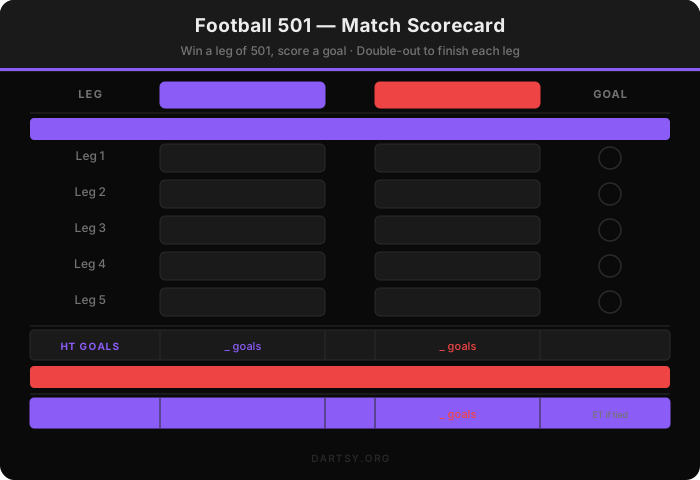
Print or copy this structure — each row is one leg, each tick in the goal circle is one goal scored.
Tips
Know your checkouts. Legs are won and lost on doubles. If you are unfamiliar with common finishes, a quick look at the 501 checkout chart before the match is worth it.
Momentum matters. Winning two or three legs in a row can swing the match like a run of goals. Maintain your routine between visits.
Adjust leg count to fit your time. Five legs per half takes roughly 45–90 minutes depending on ability. Three per half is a good option for beginners or short sessions.
Team rotation. In team formats, consider saving your strongest player for the last leg of each half — the high-pressure finish mirrors a penalty kick situation.
What is Football 501 darts?+
How many legs are in each half of Football 501?+
How does the Football 501 penalty shootout work?+
Does Football 501 use double-out?+
Who throws first in the second half of Football Darts?+
Can you play Football 501 with teams?+
Want more detail on tactics, formats, and variations?
Full Football 501 Guide — tactics, team formats, and the penalty shootout explained →